Experiment #02 · October 2026
Pointillism
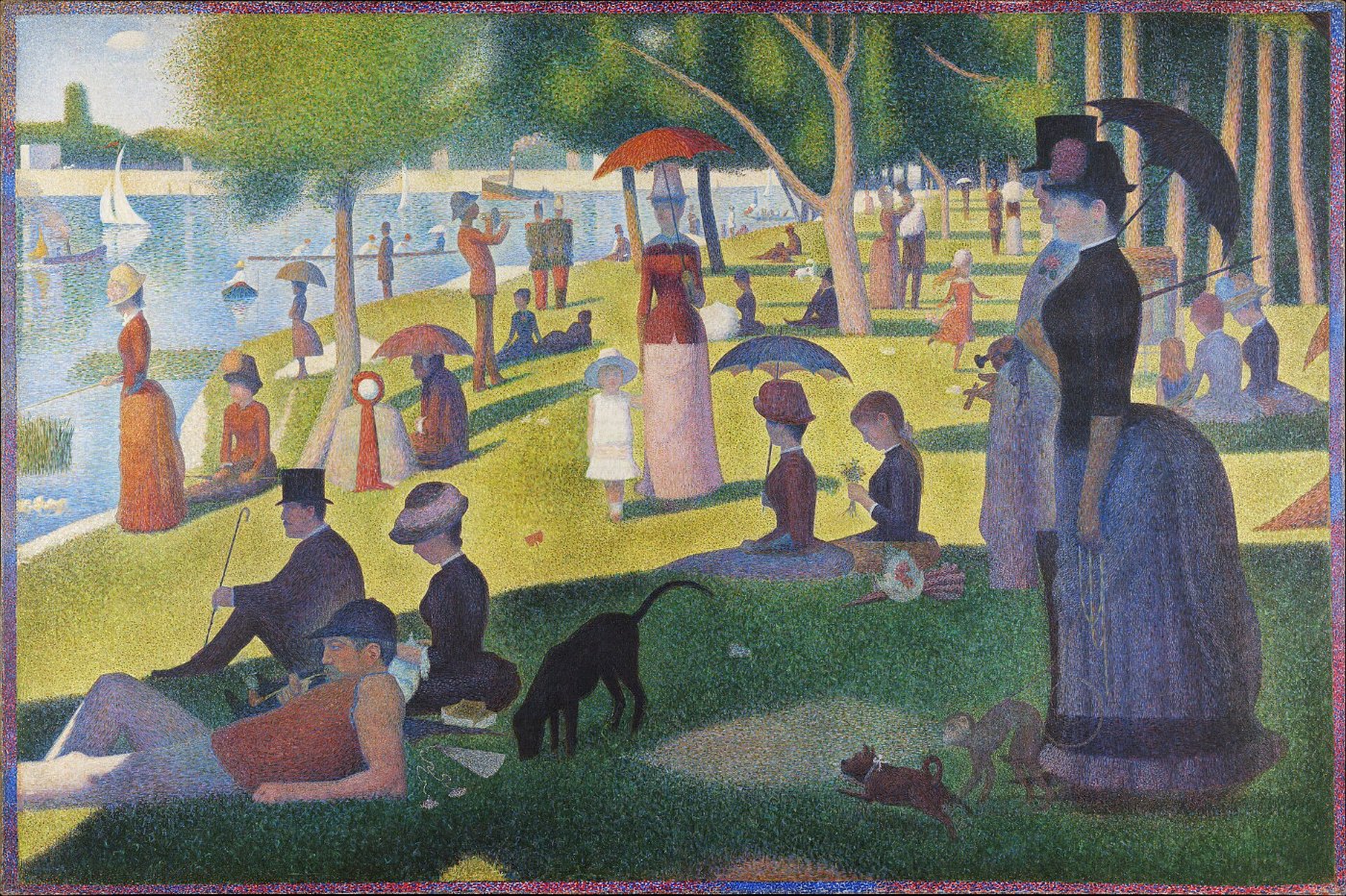
Seurat didn’t mix his colours on the palette: he laid them side by side in small, pure strokes and let the eye do the mixing. His painting is rebuilt here the same way. Move closer and the picture breaks apart into pure colour.
Preparing the strokes…
Hover over the painting to disturb the strokes. Double-click, pinch or Ctrl + scroll to move closer.
The idea
In the 1880s, Georges Seurat drew on the colour theories of his day, those of Chevreul and Rood: two pure colours placed side by side blend in the viewer’s eye, and that blend was meant to stay brighter than paint mixed with a brush. It came to be called divisionism, then pointillism.
This experiment takes his landmark painting and rebuilds it with just 15 colours. No stroke is mixed: every dot is a pure colour, and it is their neighbours that bring back the green of the lawn, the bluish shadows or the strollers’ skin. Click a colour in the swatches to see where it hides in the painting.
The artwork
Georges Seurat, A Sunday on La Grande Jatte — 1884, 1884–86, border added 1888–89, oil on canvas, 207.5 × 308.1 cm. The Art Institute of Chicago, Helen Birch Bartlett Memorial Collection. Public domain; image: Wikimedia Commons.
How it works
The painting is cut into a 600 × 399 grid. For each cell, the average colour is computed in linear light, then the closest palette colour is picked in the OKLab space, which follows perception. The difference is passed on to the neighbouring cells (Floyd-Steinberg error diffusion): on average, every area gets the painting’s colour back.
The strokes are drawn by the graphics card in a single pass. Each one is a small ellipse following the shapes of the painting. The pointer acts on a field of springs: strokes move aside, then settle back into place. Up close, they get thinner, leaving only dots of colour hanging in the dark.
- Artwork
- Georges Seurat, 1884–1886
- Rendering
- Three.js, WebGL 2
- Strokes
- 239,400 (76,840 on mobile)
- Palette
- 15 pure colours